

Welcome to the Sustainable Graduate Attribute Pack!
Being Sustainable helps you to:
- Understand how environmental, social, and economic systems are connected
- Question assumptions and think critically to support sustainable choices
- Learn about sustainable development and climate issues
- Develop creative solutions to local and global sustainability challenges
- Use your influence to make positive change
These skills are useful for your Future Me Plan, your time at University, and life after University. Being sustainable is not just about caring for the environment, it is about thinking carefully about the impact of your actions, making responsible choices, and helping create a better future for everyone.
Work through the activities in this pack to explore what it means to be a sustainable graduate, reflect on your own choices, and discover ways to make a positive impact in your studies, your community, and beyond.

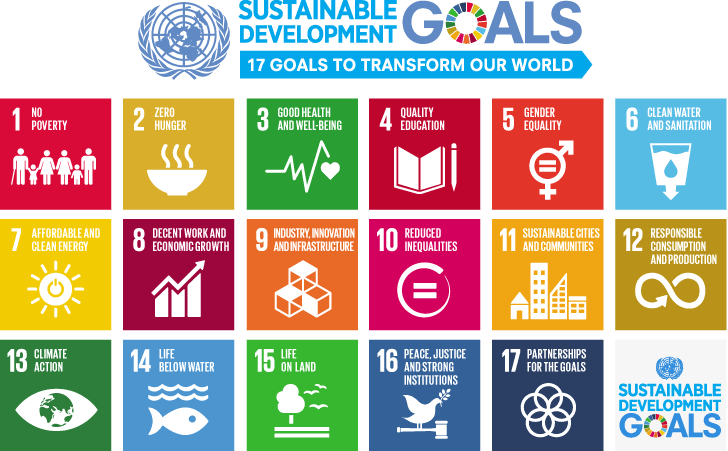
The 2030 Agenda for Sustainable Development, adopted by all United Nations Member States in 2015, provides a shared blueprint for peace and prosperity for people and the planet, now and into the future.
At the heart of the agenda are the 17 Sustainable Development Goals (SDGs), which are an urgent call for action by all countries – developed and developing – in a global partnership. They recognize that ending poverty and other deprivations must go hand-in-hand with strategies that improve health and education, reduce inequality, and spur economic growth – all while tackling climate change and working to preserve our oceans and forests.
Unit Outline:
In this course you will:
- Explore the 17 UN Sustainable Development Goals and discover the journey to reach the current goals.
- Examine the structure of the goals, breaking them down into smaller targets and actions and evaluating what these look like in the real world.
- Review case studies of the SDGs in action, with a focus on our local community in Manchester
- Described the concept of a global citizen and created a profile of our own global citizenship
This self study pack is also intended to be reflective and promote sustainable action. Throughout the course you should take time to reflect on your everday actions and choices and how you can take steps towards sustainability. You will gain the most from this intensvie by taking to the time to carefully think through the excercises and tasks. Taking part in the disucssion excercises will also help and stimulate ideas and disucssion with fellow students on the self study pack.

Explore the issues concerning business practice and sustainability challenges at a local and global level.
This course will look at some of the practical and ethical themes that impact business practice, and consider opportunities that businesses can utilise in order to be more sustainable and contribute to the wider objectives and recommendations set by the United Nations in their Sustainable Development Goals (UNSDGs).
Using an industry/business of your choice, you will have the opportunity to actively apply the themes covered to that industry/business as a way to reflect upon the viability of approaches to changing practice, and discover that there may be no easy or simple answers to this issue. Yet this insightful journey can support with wider, critical, thinking and contemplation about how society functions at both the macro and micro levels.
As sustainability grows in importance and urgency, this packs helps you gain knowledge on sustainable aptitudes and practices that are relevant and applicable to academic and professional settings.
it is critical for the health of our planet and the global community that sustainability is at the forefront of all human activities. An increasing number of organisations are taking on and investing in corporate social responsibility and therefore seeking graduates with knowledge and skills within the field of sustainability. This course provides you with key competencies and concepts in sustainability including social awareness, sustainable economies, and global citizenship. The course will also guide you through self-reflection on your existing skillset and motivations to pursue sustainability within and beyond your academic career.
Graduate Attributes: Community and global social awareness / Self-motivation / Taking responsibility

The pack challenges the traditional view that financial performance should come at the expense of the planet or society. Instead, it highlights how businesses and individuals can contribute to a more sustainable future while still achieving strong financial outcomes.
Discover how to use finance can be used for a force for good and how businesses can contribute to building a more sustainable world.
Explore the connection between finance and sustainability, and understand how money can be used as a force for good.
This Self Study Pack introduces students to the principles of sustainable finance, a growing field where financial decisions are made not only for profit, but also for positive environmental and social impact. It covers core topics such as ESG investing, green financial products, climate risk, and the role of financial institutions in sustainability.
The pack challenges the traditional view that financial performance should come at the expense of the planet or society. Instead, it highlights how businesses and individuals can contribute to a more sustainable future while still achieving strong financial outcomes.
You’ll gain the foundational knowledge needed to navigate this space—whether you’re considering a career in finance, working on a sustainability project, or simply curious about how financial systems influence the world around us.
If this inspires even one person to think differently, then it has served its purpose.
Here’s my motivation:
I created this self-study pack because I believe finance shouldn’t be exclusive or intimidating. Everyone deserves to understand how money works — and how it can be used responsibly. In today’s world, most businesses prioritise financial performance above all else. But I believe we can build profitable models that also protect the environment and contribute positively to society. We have the right to benefit from this planet, but we must also respect it and preserve it for future generations.
This pack is my way of making finance more accessible, conscious, and human.

Explore the PESTLE analysis tool to understand how different factors impact the world of business.
Welcome to the PESTLE analysis unit, in which the implications for the use of this tool are explored and the benefits to managers of organisations having a deep understanding of political, economic, social, technological, legal and environmental issues.
We’ll explore these issues from the perspective of businesses, and this course will examine the impact they have on each other, from a local to global level. To operate in the complex world of business, managers can use the PESTLE framework to take account of their organisations’ current and developmental positions from both short-term and long-term perspectives

Welcome to this self study pack, where we explore the vital intersection between digital technologies and sustainability. As our reliance on ICT continues to grow, so too does its environmental and social impact. This study pack will help you understand how technology both contributes to global challenges - such as climate change, resource consumption, and e-waste - and offers powerful tools to address them.
Throughout the study pack, you will develop a systems-thinking approach to sustainability, examining how digital systems interact with environmental, economic, and social factors. You’ll engage with real-world case studies, practical frameworks, and emerging innovations that aim to reduce environmental impact while promoting responsible and ethical use of technology.
By the end, you will be equipped with the knowledge and skills to critically evaluate digital solutions, design more sustainable systems, and contribute to a more resilient and environmentally conscious future.
